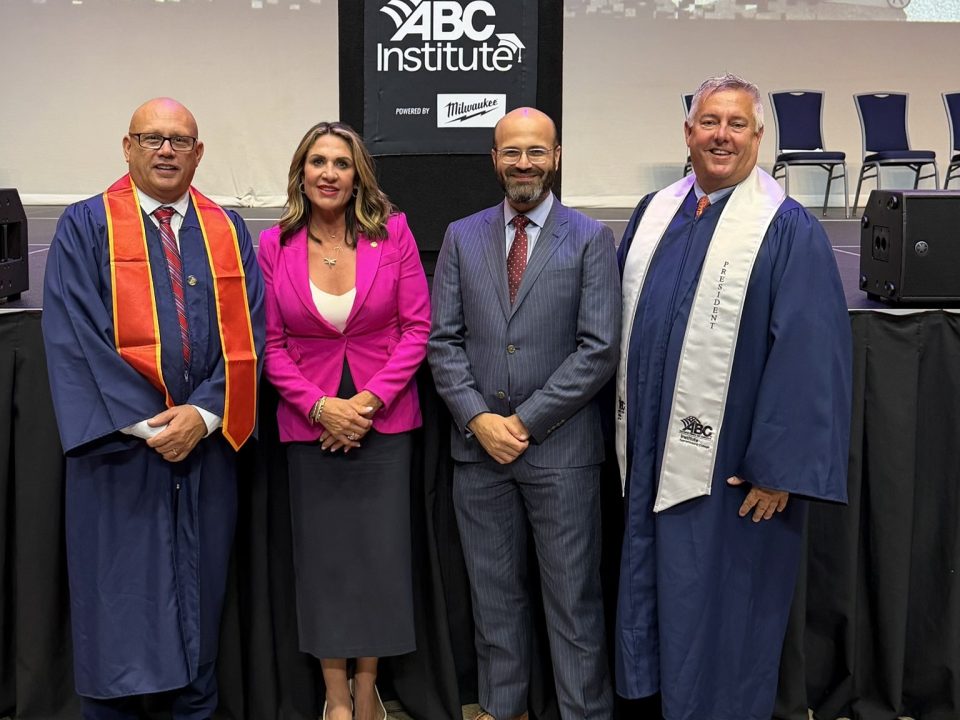

Elected Officials Visit ABC Florida East Coast
May 5, 2026
ABC Cares Thanks ANF Charitable Fund, Pillar Level Donor
May 6, 2026 The 2026 midterms are rapidly approaching, with Election Day now just over three months away. Unsurprisingly, this election cycle is shaping up to be highly competitive, as Republicans seek to maintain their narrow majorities in both the U.S. House of Representatives and U.S. Senate. Control of Congress is likely going to be determined by a handful of battleground races. The Cook Report, an independent, nonpartisan newsletter that tracks American election and political trends, has identified 18 House races and four Senate races as true toss-ups.
Recent polling shows Democrats hold a modest advantage in regaining control of the House, needing only a handful of seats to secure the majority. Midsummer marks an awkward phase of the election cycle, as some states have already held their primaries while others are scheduled between late July and early September.
Arizona is home to several of the nation’s most competitive races in the country. Following Arizona’s July 21 primary, key races to watch include Arizona’s 1st and 6th House districts. Former NFL player Jay Feely is the official Republican nominee after winning the primary in Arizona’s 1st. Arizona’s 6th District is another tight race to watch, with incumbent Republican Juan Ciscomani fighting to hold his seat in an evenly divided district.
Other top House races to monitor include: California’s 2nd District, Colorado’s 8th District, Florida’s 25th District, Iowa’s 1st and 3rd districts, Michigan’s 7th District, New Jersey’s 7th District, Ohio’s 9th District, Pennsylvania’s 8th and 10th districts, Texas’ 34th District, Virginia’s 2nd District, Washington’s 3rd District and Wisconsin’s 3rd District. Florida, Michigan and Virginia have yet to hold their primaries.
The battle for Senate control is more complicated, with Republicans currently holding 53 seats, Democrats holding 45 and Independents with two (both of whom caucus with Democrats). While Republicans currently hold the majority, Democrats only need to flip four seats in November to gain the majority. This outcome is expected to be determined by a few key races, namely Georgia, Maine, Michigan and North Carolina.
In Georgia, Democratic Sen. Jon Ossoff is seeking reelection in a state won by President Donald Trump in 2024. Ossoff faces Republican U.S. Rep. Mike Collins in one of the most closely watched races of the cycle.
Maine has drawn significant national attention following a series of scandals associated with former Democratic nominee Graham Platner, who has since withdrawn from the race. Over the weekend, Troy Jackson was formally nominated as the Democratic nominee for Senate, replacing Platner. Despite Platner’s withdrawal, the race is still considered a competitive one. Recent tariff disputes regarding the Canadian wildfires and heightened immigration policy backlash make for a tough fight for sitting Republican Sen. Susan Collins.
In North Carolina, former Gov. Roy Cooper, a Democrat, is head-to-head with former North Carolina Republican Party Chairman Michael Whatley following the retirement of current Sen. Thom Tillis.
Meanwhile, Michigan is awaiting its primary on Aug. 4. Republican nominee and former U.S. Rep. Mike Rogers will face either epidemiologist Abdul El-Sayed or U.S. Rep. Haley Stevens. Recent polling shows El-Sayed ahead of Stevens in the Democratic primary, despite Stevens receiving support from the party establishment.
Other Senate races to watch include Alaska, Iowa, Minnesota, New Hampshire, Ohio and Texas.
With months of campaigning, changing candidate performance and shifting voter sentiment until November, it will continue to be an intense and closely monitored election season. Both parties appear to have a realistic path to victory. Continue to stay abreast with Newsline as we head into Election Day.